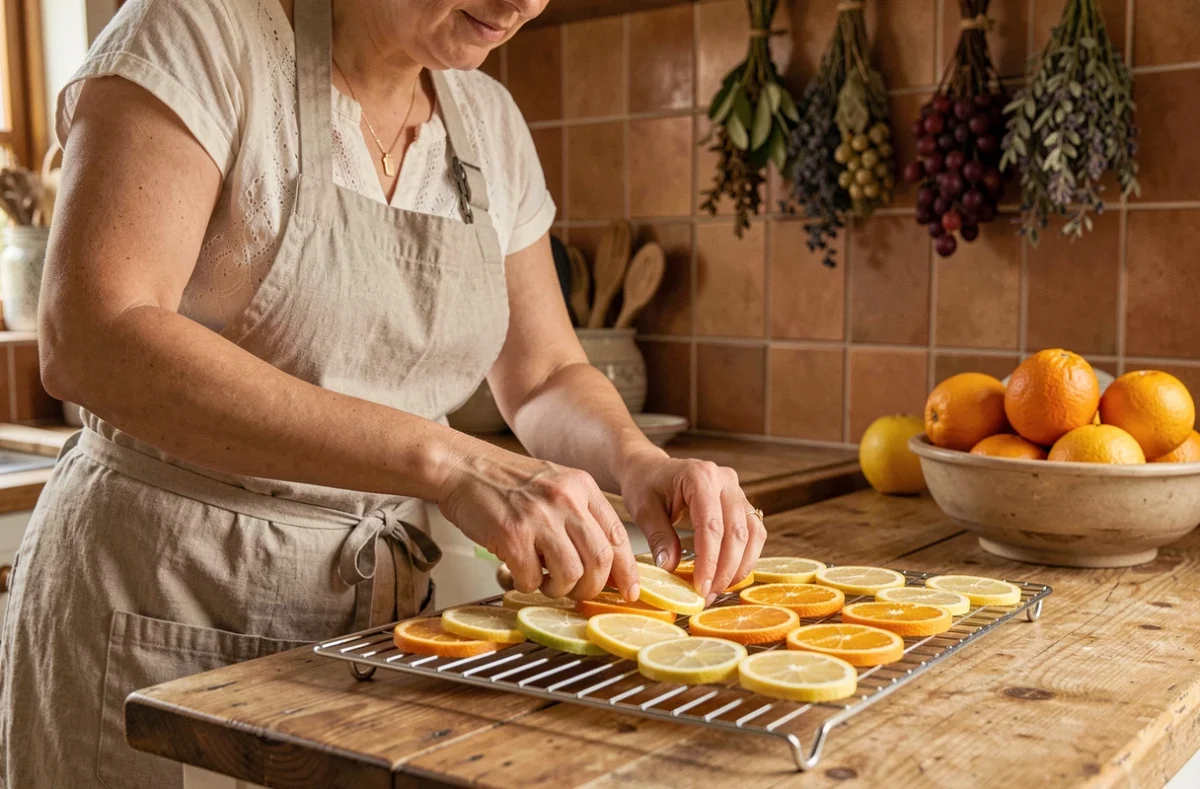
A translucent orange slice resting on the edge of a glass, a crunchy lemon zest slipped into an infusion: the dehydration of citrus transforms ordinary fruits into durable and decorative ingredients. The principle is simple, but a few technical details make the difference between a soft, fragrant slice and a blackened or still moist disk in the center.
Cutting Thickness and Preparation of Citrus Before Drying
Before even thinking about the temperature, it is the cutting technique that determines the result. A slice that is too thin shrivels and becomes brittle. A slice that is too thick retains moisture in the center, compromising its preservation.
Aim for a consistent thickness, close to one centimeter. A sharp knife is sufficient, but a mandoline ensures uniformity. Uniformity matters because slices of different thicknesses on the same tray do not dry at the same rate.
Have you noticed that some slices brown faster than others? This is often related to the seeds and the white pith. Remove any visible seeds. The skin, however, remains in place: it maintains the shape of the slice throughout the drying process.
To find more tips for dehydrated lemon and other citrus, using organic fruits is preferable if you plan to consume the skin, as treatment residues concentrate on the surface during dehydration.
Temperature and Duration of Dehydration in an Oven or Dehydrator
The choice of temperature directly influences the final texture and color. Two methods coexist, each with its constraints.
Electric Dehydrator
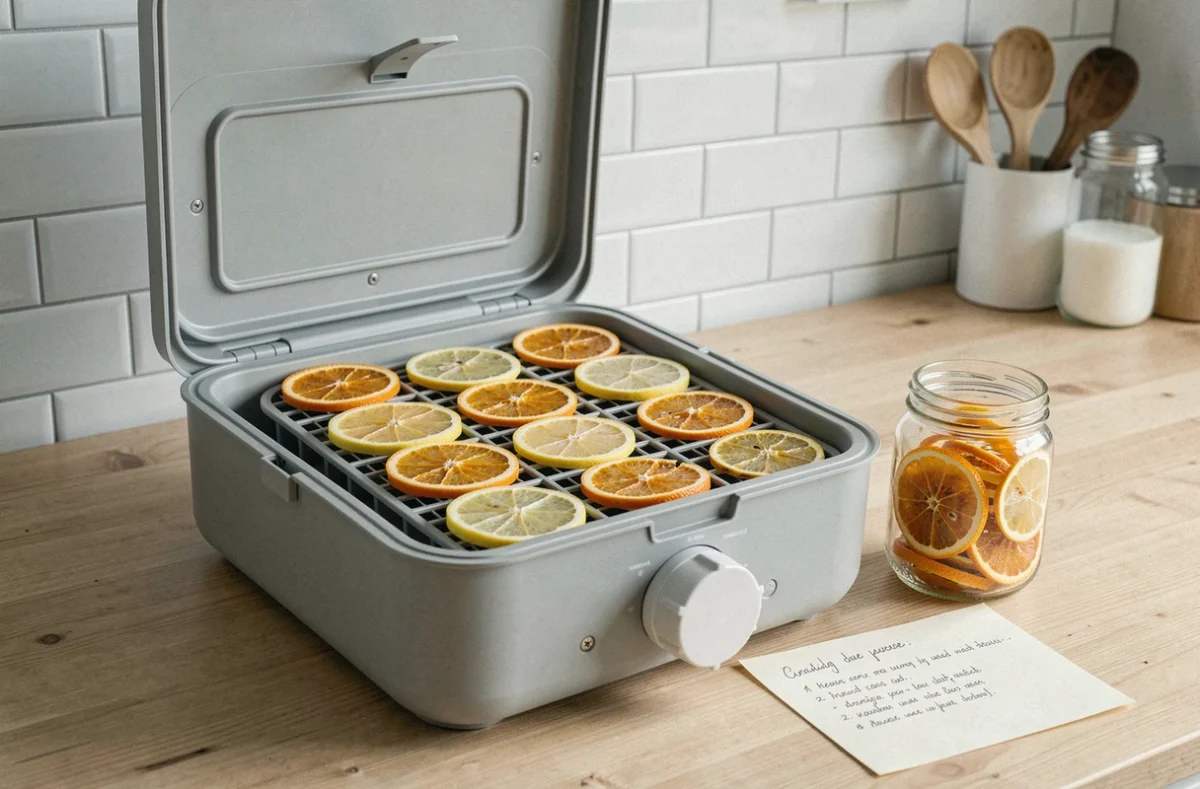
This is the most suitable tool. Air circulates evenly around each slice, and the temperature remains stable. Set it to a low heat, sufficient to evaporate the water without cooking the fruit. The duration varies according to the thickness and juice content of each citrus: a lime, less juicy, dries faster than a sugar-laden navel orange.
Convection Oven
Without a dehydrator, the oven works, provided you use it correctly. Keep the oven door slightly ajar to allow moisture to escape. Without this ventilation, steam gets trapped and the slices soften instead of drying.
Place the slices directly on the rack rather than on a tray. Contact with a flat surface prevents air from circulating beneath the slice, creating a point of residual moisture.
Flip the slices halfway through for even drying. The sign that the process is complete: the slice is firm, slightly flexible, with no soft area in the center. If it sticks to your fingers, it needs more time.
Complete Drying Test and Common Mistakes with Citrus
Here’s the most common pitfall: removing the slices too early. A citrus that appears dry when coming out of the oven may still contain enough moisture to mold in a jar after a few days. A properly dried slice does not bend without resistance.
Let the slices cool completely in the open air before touching them. Residual heat gives a false impression of flexibility. Once at room temperature, the final texture reveals itself.
The most common mistakes:
- Stacking the slices or overlapping them on the rack, which blocks air circulation and creates moist areas
- Using overly ripe fruits whose high sugar content causes excessive browning and a sticky texture
- Increasing the temperature to speed up the process, which cooks the outside while leaving the center moist
Storage of Dehydrated Citrus: Jars, Temperature, and Duration
Packaging after drying is not just a simple storage step. It is a control in its own right. According to the recommendations of the National Center for Home Food Preservation, dried fruit retains its quality better at cool temperatures than at high room temperatures.
In practical terms, a cupboard away from heat sources (oven, dishwasher, radiator) extends shelf life. A cupboard located just above the stove significantly shortens this duration.
Choosing the Container
Opt for an airtight glass jar. Glass does not transmit odors and allows you to visually spot any signs of condensation, indicating that the drying was incomplete.
- Fill the jar two-thirds full to leave minimal air space
- Check the inside of the lid after 24 hours: droplets indicate excess residual moisture
- In case of condensation, return the slices to the oven or dehydrator for an additional session
Drying does not make citrus sterile. It reduces the water available for microorganisms but does not destroy all present agents. A slice that is still soft or moist to the touch should not be considered stable at room temperature.
Drying Differences Between Lemons, Oranges, and Grapefruits
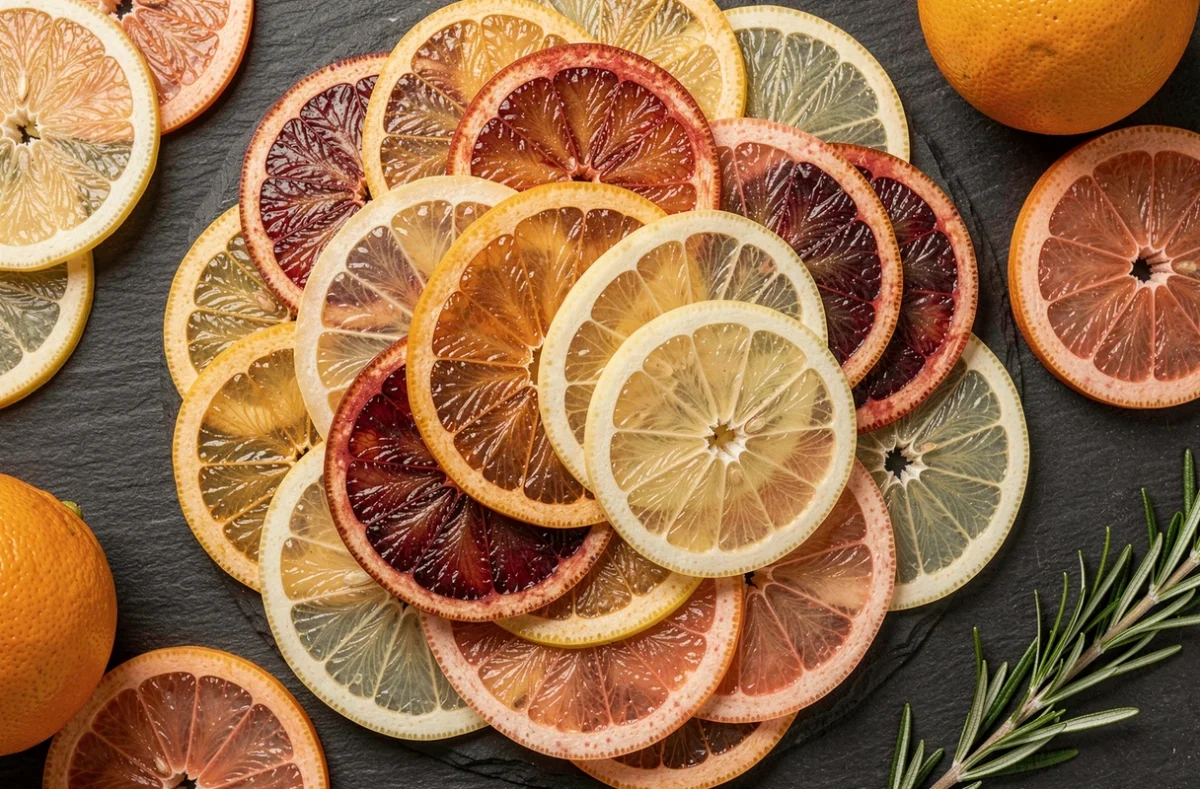
Not all citrus behave the same way when drying. Yellow lemon, relatively acidic and low in sugar, dries faster and produces almost translucent slices. The orange, sweeter and juicier, requires more patience and produces more colorful slices, slightly caramelized on the surface.
The grapefruit, with its large, water-filled segments, takes the longest to dehydrate. Its slices shrink more than those of other citrus, which justifies an initial cut that is a bit thicker.
The lime, compact and less juicy, yields quick results and slices of a deep green, perfect for decorating cocktails or mocktails. Its thin skin dries evenly, making it the simplest citrus to succeed with for a first attempt.
Adapt the drying time to each fruit rather than treating all citrus the same way on the same tray. If you mix lemons and oranges, remove the lemons first and let the oranges continue drying alone.
The dehydration of citrus relies on three parameters that do not tolerate approximation: a consistent cut, low heat with air circulation, and packaging in an airtight container checked after 24 hours. The rest is a matter of patience.