
A sick child on a Tuesday morning, no childcare solution, a video conference at 9:30 AM: we all know this scenario. Remote work and children at home is an organization that builds itself daily, not an ideal that is achieved once and for all. Generic advice like “make a schedule” is not enough when a three-year-old bursts in during a client call.
Parental mental load in remote work: what really weighs on the day
We often talk about concentration, rarely about what sabotages it beforehand. Even before opening a file, a parent working remotely has already managed breakfast, checked the communication notebook, and anticipated lunch. This accumulation of invisible micro-tasks eats away at work capacity long before the first interruption from a child.
The Ifop barometer for News RSE published in 2025 confirms a clear imbalance: mothers report a higher mental load related to monitoring schooling than fathers. School messages, activity registrations, medical appointments: these tasks are still mostly carried by one parent, even when both are working remotely.
The issue is therefore not just to keep the children occupied during work hours. It is to explicitly share the invisible tasks between adults in the household by listing them black on white. What is not named is not shared.
For parents looking to manage remote work with children in the long term, this distribution forms the foundation of any sustainable organization.

Block protected time slots rather than an ideal schedule
A minute-by-minute schedule never holds up against the reality of a home with children. What works better is to identify two or three non-negotiable time slots in the day, those where concentration must be at its peak (calls, writing, deadlines).
Protecting two 90-minute slots is better than a fictitious 8-hour schedule. We schedule these blocks during times when the children are naturally occupied: nap time for the little ones, school time for the others, or a designated screen time slot at the end of the day.
For the rest of the time, we accept a degraded mode. Responding to emails with a child beside you, sorting documents while they draw: that’s work, even if it doesn’t look like a classic office day.
Negotiate with your employer rather than compensating alone
Many parents absorb the constraints without saying anything. In France, when an employee caring for a child with a disability requests remote work, the employer must provide concrete reasons for any refusal. This procedural protection remains largely unknown.
For other situations, there is no legal obligation guaranteeing remote work. Responses on this point vary according to company agreements. However, clearly communicating parental constraints to one’s manager often allows for adjustments to meeting times or rescheduling certain tasks. Transparency is not an admission of weakness; it is an organizational lever.
Warning signs: when parental remote work tips into exhaustion
We get used to functioning in survival mode. The problem is that this habit masks serious signals. Inserm has documented that remote-working parents are more exposed to stress and chronic fatigue than on-site employees, largely due to the constant confusion between professional and family life.
Here are the concrete signs to watch for:
- Working systematically after 10 PM to catch up on lost hours during the day, several times a week
- Having no moment in the day without dual tasks (work + child or household task + work)
- Feeling guilt in both directions: not present enough for the children, not performing enough at work
- Giving up all personal activities (sports, reading, outings) for several weeks
One of these signs can be occasional. Two or three combined over several weeks indicate an imbalance that will not be resolved with a better schedule.
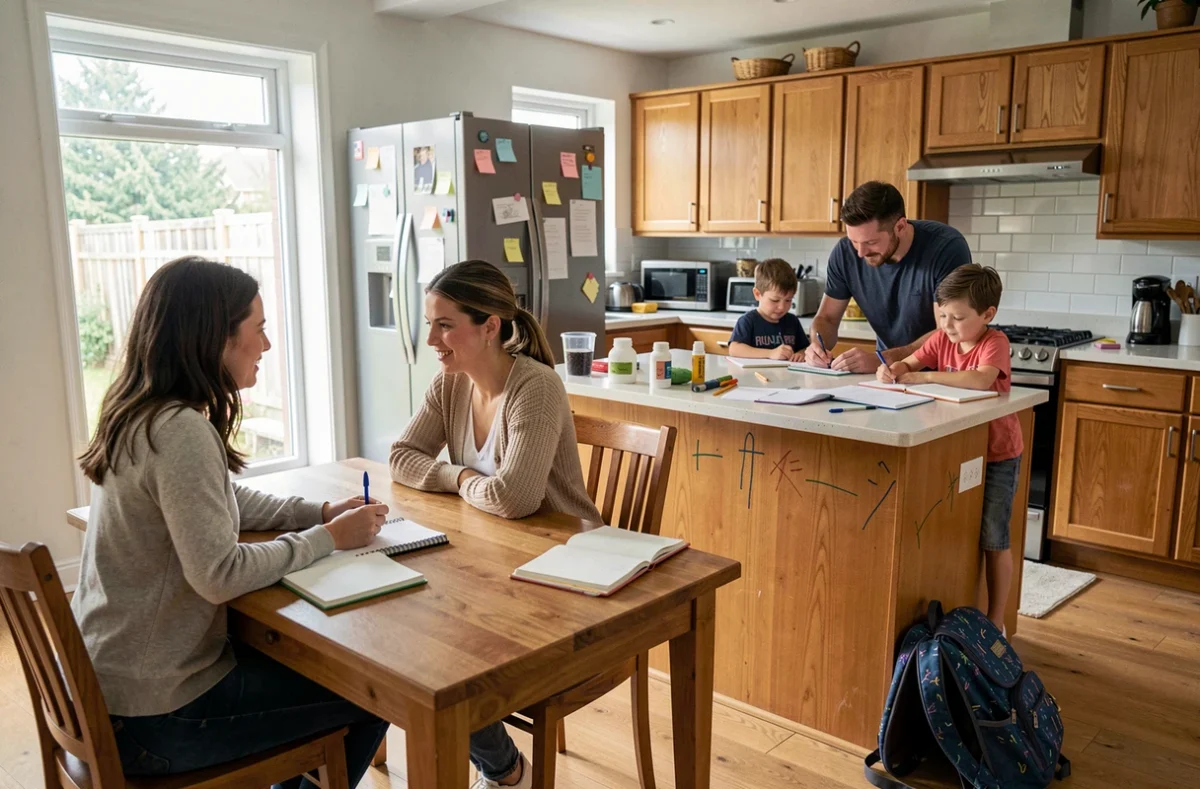
Concrete adjustments to the workspace with children at home
Not everyone has a dedicated room. In a family apartment, we make do with what we have. The goal is not to have a perfect office, but a clear physical signal that distinguishes work time from parental time.
A noise-canceling headset on your head, a closed door, a simple sign hung on the doorknob: these visual markers work even with young children. The idea is to create an understandable boundary, not a watertight one. A child who sees a clear signal interrupts less than a child facing a parent who is “available but not really.”
Adapting the space according to the children’s age
With a child under three, working in the same room as them is often the only realistic option. Set up your workstation in the living area, close to a secure play space.
From the age of six, you can start to set temporal rules: “when the door is closed, you wait unless it’s an emergency.” It doesn’t work every time, but repetition gradually establishes the reflex. The realistic goal is to reduce interruptions, not to eliminate them.
Professional consequences of removing remote work for parents
A recent ruling from the Paris Court of Appeal examined the case of a remote-working employee living 500 kilometers from their company, dropping off and picking up their two children from school, without alternative childcare solutions. The removal of remote work would have simultaneously affected their housing, commuting, childcare costs, and entire parental organization.
This case illustrates a rarely addressed angle: remote work is not a comfort for many parents; it is an infrastructure. When it disappears, the entire architecture of daily family life collapses. Before giving up a remote position or accepting a return to the office without negotiation, it is worth checking what the company’s remote work agreement or charter stipulates and formalizing your constraints in writing.
Managing remote work with children is not just about finding activities to keep them occupied. It’s about arbitrating daily between conflicting priorities, setting visible limits in space and time, and refusing to bear alone a burden that concerns the entire household.