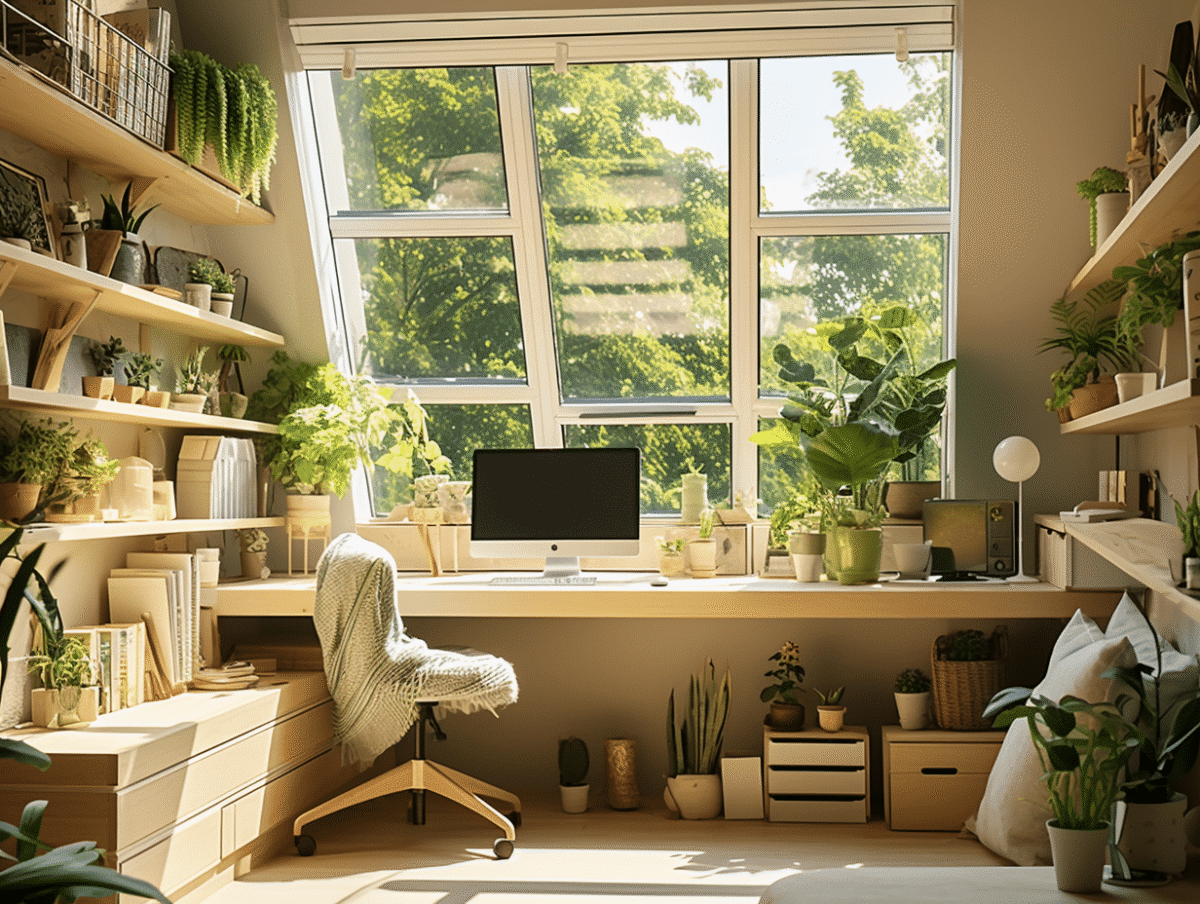
In the post-pandemic era, many individuals have been prompted to rethink their homes as workspaces. Long hours in front of screens, the importance of separating professional and personal life, and the need to maintain a high level of productivity have created a growing demand to reinvent these spaces. Creative solutions abound, from integrating ergonomic furniture to adopting smart technologies and innovative organizational methods. This reconfiguration is crucial to ensure both well-being and efficiency in a context where the boundaries between office and home are becoming increasingly blurred.
Optimizing your home workspace for comfort and efficiency
In the wake of the health crisis, profound changes have marked the traditional corporate office. The shift towards hybrid work has forced organizations to reinvent their workspaces, pushing many employees to set up their home office. Indeed, working from home is not without challenges, particularly the noise disturbances that can compromise concentration and, consequently, productivity.
The Kiwik concept, an innovation in workspace optimization, offers solutions to counter these disruptions. It is a modular system that allows for the creation of a personalized and adjustable workspace based on each worker’s specific needs. This arrangement, which takes into account acoustic and ergonomic comfort, promotes a home working environment as effective as that of a corporate office.
In light of the rise of third places, employees are expressing a growing interest in alternatives to conventional work environments. These spaces, often designed to address the shortcomings of home offices, are emerging as hybrid solutions where sharing and collaboration are key. The demand for these places is increasing, leading to a broader reflection on the design of workspaces, whether at home or in dedicated structures.
The keys to successfully transforming your home office into a productivity-friendly space
Remote work requires rethinking the layout of the home office, transforming it into a productivity space. To achieve this, Quality of Life at Work (QVT) proves to be a reliable compass. Organizations such as Microsoft, Danone, Ogilvy & Mather, and Bodet Software have already taken bold steps to improve QVT by creating spaces that promote well-being and focus. Follow their example and consider introducing elements that contribute to a serene and dynamic atmosphere within your personal workspace.
In the quest for an optimal workspace, flexibility is key. Hybrid offices and flexible workspaces have replaced traditional open spaces in many companies. These modular spaces lend themselves to various configurations, allowing for a shift from individual work to a collaborative environment. For your home office, adapt this approach by creating a space that can be reconfigured according to the tasks at hand, whether they require quiet or collaboration.
The rise of flexible workspaces in the region highlights a trend towards decentralization. The Instant Group France reports an increase in demand for these places outside major metropolitan areas. Consider this enthusiasm as an indicator of the evolving professional needs that extend beyond the limits of the city. For those working from home, this means that the design of an office should not be limited to mimicking the urban environment but should also incorporate elements of regional life to inspire and revitalize.
Collaborative work remains a central aspect of modern offices. In your home office, ensure you have the necessary tools for smooth communication and unhindered idea sharing. Whether through the installation of whiteboards, the use of project management software, or the establishment of a dedicated video conferencing corner, these arrangements are essential to maintain a spirit of collaboration and daily efficiency.