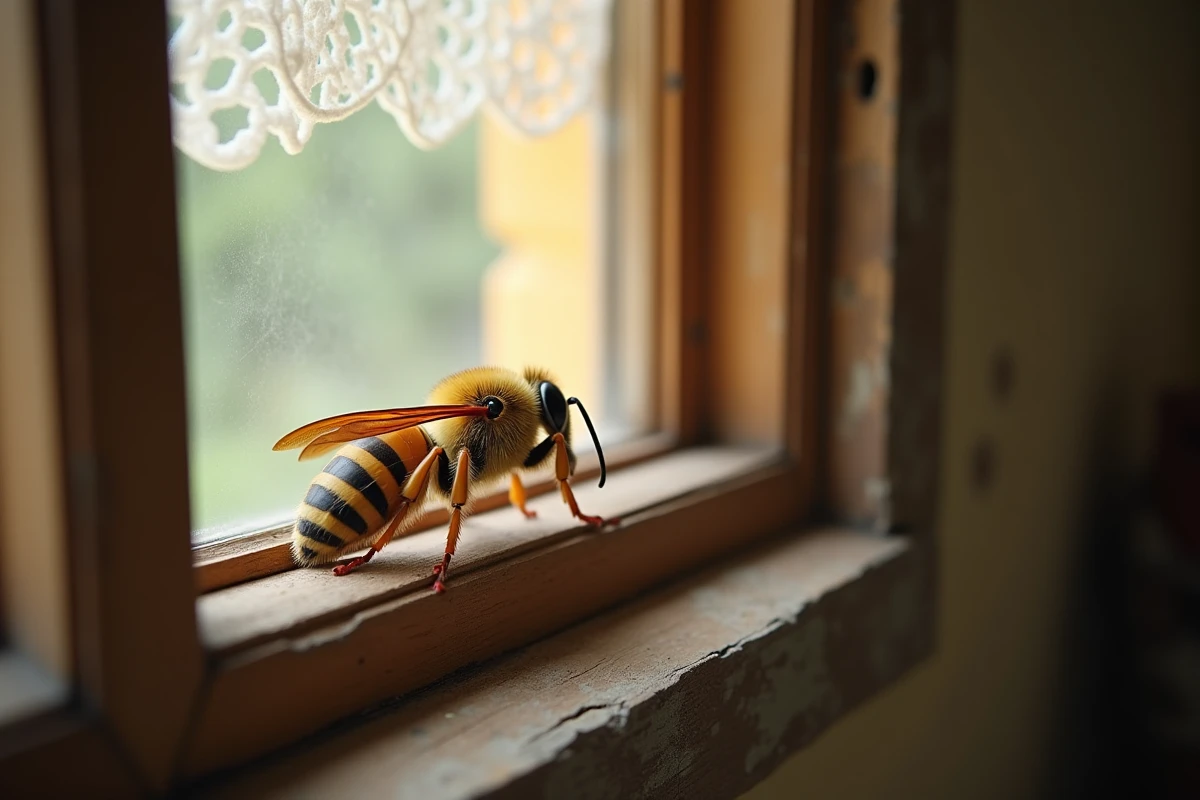
A wasp that enters a living space is almost never a lost individual. We systematically observe that this presence reflects an exploratory behavior related to the search for food, building materials for the nest, or a nesting site. Before seeking a hidden meaning, one must read what the wasp reveals about the state of your habitat and its immediate environment.
European wasp or Asian wasp in the house: entomological reading
The first useful piece of information is the identification of the species. Vespa crabro (European wasp) primarily enters at night, attracted by light sources. Its flight is noisy, its size imposing, and it often bumps against windows or light fixtures. Vespa velutina (Asian wasp) has a diurnal behavior and enters more discreetly, often through high openings: roller shutter boxes, attic vents, roof interstices.
This distinction changes everything. An isolated European wasp entering through an open window in the evening indicates nothing more than a common phototropism. Several Asian wasps over a few days, on the other hand, signal the proximity of a nest, potentially located on the building itself.
We recommend examining the symbolism of the wasp in the house in addition to the naturalistic approach, as the two readings do not oppose each other: understanding what the animal represents culturally helps to overcome fear and act rationally.
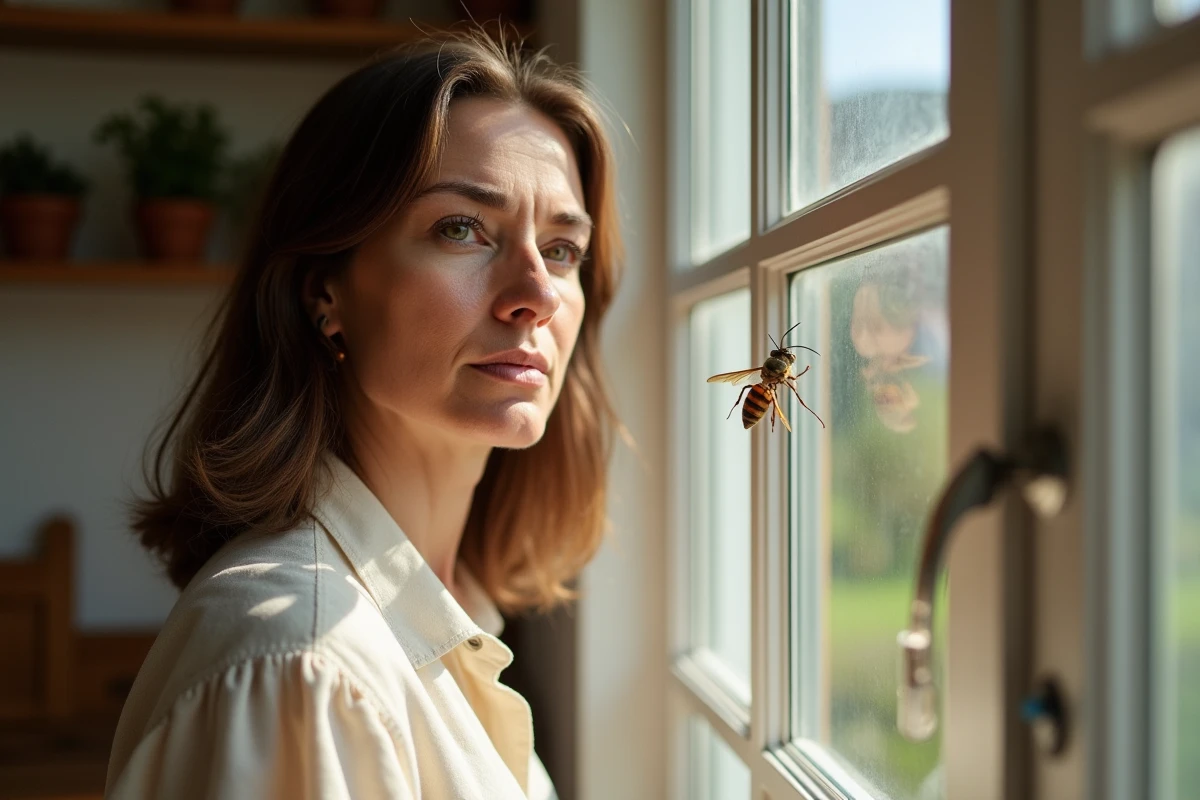
Primary nest in the building: what the wasp signals about your habitat
The National Museum of Natural History, through the participatory science program “Asian Wasp Alert,” reports a sharp increase in the discovery of primary nests on or in buildings since 2022. The urbanization of Vespa velutina and the scarcity of certain natural nesting sites explain this trend.
A primary nest is a structure the size of a ping-pong ball, built in spring by a solitary founding queen. It is located in protected and little-frequented places:
- Roller shutter boxes, where darkness and residual heat create a favorable microclimate
- Overhangs, gutters, and under balconies, sheltered from direct rain
- Attics, garden sheds, and poorly ventilated garages, where the queen finds a stable anchoring point
The repeated presence of wasps in a specific room (always the same bedroom, always the same hallway) betrays a direct access from a nest located within the building’s structure. This is not an esoteric sign: it is a sealing defect.
Interpreting the frequency of appearance
An isolated individual once does not justify any particular action. Two to three wasps per week in the same area of the house call for an inspection of the attic and roller shutter boxes. Beyond that, we consider that a nest is installed in the immediate vicinity and that professional intervention is necessary before the primary nest transforms into a secondary nest, which is much larger and populated.
Symbolic meaning of the wasp: cultural and psychological reading grids
Beyond entomology, the presence of a wasp in a domestic space has generated interpretations in several traditions. These readings are not scientific, but they structure how many people experience this event.
In rural European traditions, a wasp entering a house is often associated with a warning of conflict or latent tension. Its deep buzzing, size, and potential for stinging make it a symbol of contained aggression. The animal embodies what threatens from within, what has not been wanted to be seen.
In Jungian psychology, the stinging insect that enters intimate space (the house as an extension of the psyche) refers to a repressed emotion that “forces its way in.” The wasp does not represent external danger, but the shadow aspect that demands the conscious’s attention.
Wasp as a totem animal: protection and combativeness
In shamanic and neo-shamanic currents, the wasp is associated with territorial defense and the ability to protect one’s own. Its presence in a home would then be a call to strengthen personal boundaries, to stop tolerating what encroaches on one’s vital space.
This reading grid emphasizes a paradox: the animal that frightens is the one that protects. The wasp builds, organizes, and defends an entire colony. Interpreting it solely as a threat ignores half of the symbolic message.
Wasp sting at home: react according to updated recommendations
If the encounter goes wrong, medical guidelines have evolved. The French Ministry of Health revised its recommendations on stings from hymenoptera in 2023. Key points to remember for a domestic context:
- Anyone who has previously had a generalized reaction (extensive hives, respiratory distress, malaise) should have a home adrenaline auto-injector
- At-risk profiles (severe asthma, mastocytosis, heavy allergic background) should consider any wasp sting at home as an emergency to be actively monitored
- Even in the absence of an allergic history, a sting in the ENT area (mouth, throat, neck) requires an immediate call to 15
The domestic location increases the risk due to proximity to vulnerable individuals (children, elderly people) and the panic effect in enclosed spaces, which multiplies sudden movements and thus defensive stings.
Whether it is an entomological signal about the state of your building, a symbolic mirror, or a concrete health risk, the wasp in the house deserves a graduated response. Identifying the species and frequency of appearance remains the first useful reflex, the one that conditions everything else.